

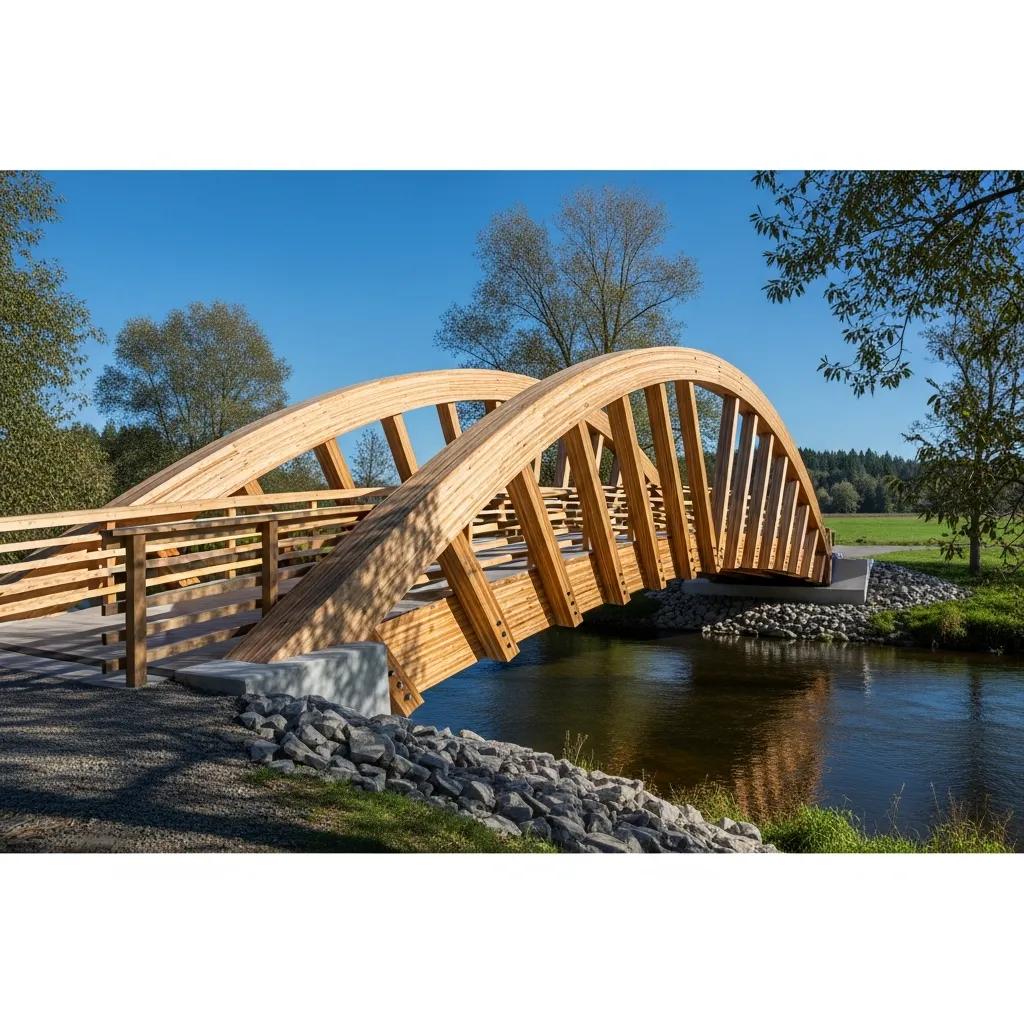
Stress-Laminated Timber Bridges: Why They’re Popular for Rapid Deployments
Stress-laminated timber (SLT) bridges are a fast, reliable option for temporary or quickly installed permanent crossings. Made from engineered timber compressed and prestressed into a single deck, SLT offers strong load performance with sustainability benefits. This article explains how SLT works, why it installs quickly, common uses, and what to expect for maintenance and environmental performance. For more information on engineered timber solutions, visit E&H Manufacturing.
What Are Stress-Laminated Timber Bridges and Their Key Features?
SLT decks are formed by placing parallel timber planks or glulam beams side by side and compressing them under high prestress so they act as a unified deck. The prestress creates friction between laminations so loads are shared — typical per‑lane capacities often fall in a practical working range depending on design and species. Materials are generally high‑grade and preservative treated for durability. The method uses renewable timber efficiently and reduces material waste compared with some conventional decks.
Research and practice underline the core principles that make stress‑laminated decks reliable and widely adopted in bridge engineering. Learn more about the design and manufacturing process at E&H Manufacturing’s Stress Laminated Timber Bridge services.
Popularity and Construction of Stress-Laminated Timber Decks
Stress‑laminated timber (SLT) decks are a widely used structural system in bridge engineering. They consist of parallel timber beams placed side by side and prestressed to act together as a continuous deck, relying on friction between lamellas and the prestressing system to distribute loads. Stress-laminated timber decks in bridges: Friction between lamellas, butt joints and pre-stressing system, FM Massaro, 2020
How Does Stress Lamination Strengthen Timber Bridges?
High‑strength steel tension rods compress the timber laminations so friction transfers loads between boards. That shared load path reduces stress concentrations and increases stiffness. Properly detailed SLT decks can meet AASHTO guidance for many short‑ and medium‑span uses, giving designers a dependable, code‑compliant option.
Because load is shared through friction and prestress, SLT often provides a cost‑effective, high‑performance alternative to conventional decks for appropriate sites.
Stress-Laminated Timber Bridge Decks: Cost-Effective & High-Performance
Stress‑laminated timber (SLT) bridge decks can be a practical alternative to conventional short‑ and medium‑span bridges in both cost and performance. SLT decks are formed from planks or glulam beams placed side by side and prestressed with high‑strength steel bars so concentrated loads transfer to adjacent beams through the resisting friction created by prestress.
Stress-laminated-timber decks: state of the art and design based on Swedish practice, R Kliger, 2016
What Are the Modular Components of SLT Bridges?

SLT bridges use repeatable, prefabricated modules that shorten on‑site work. Typical components include:
- Timber laminated deck panels: Driving surface formed by laminating planks under compression.
- Steel tensioning rods and hardware: High‑strength rods that produce the compressive force.
- Bearing assemblies and abutments: Support the deck and transfer loads to foundations.
- Quick‑connect hardware: Fast assembly and disassembly features for temporary or moveable installations.
(Note: SLT bridges typically do not include steel truss spans as part of their modular system.)
Why Are SLT Bridges Ideal for Rapid Deployment and Temporary Use?
Prefabrication, standardized interfaces, and modular connections let contractors erect large sections with minimal heavy civil work. That reduces site disturbance and shortens construction windows — especially valuable in emergencies or when temporary crossings are needed. Explore versatile options at E&H Manufacturing’s Temporary Bridges solutions.
How Fast Can Stress-Laminated Timber Bridges Be Installed?
With prepared foundations and good access, many SLT bridges can be installed in one to three days. Most on‑site time is placement and tensioning; prefabricated components make the process efficient and safe.
What Makes SLT Bridges Cost-Effective for Low Volume Traffic?
SLT reduces on‑site labor and equipment use, has modest maintenance demands, and components can be reused. Routine inspections and straightforward upkeep keep life‑cycle costs competitive for rural roads, forest access, and temporary project crossings.
Which Industries Benefit Most from Temporary and Modular Timber Bridges?
Several sectors value SLT for speed and flexibility. Primary users include:
- Construction and logging: Temporary access for heavy equipment during project phases. See Temporary Logging Bridges by E&H Manufacturing for forestry operations.
- Emergency response: Rapidly restores crossings after floods, landslides, or disasters. Learn about Emergency Temporary Bridges for disaster recovery.
- Government and land development: Temporary crossings during construction while meeting environmental and permitting constraints. Check out Construction Site Temporary Bridges for project sites.
How Are SLT Bridges Used in Agriculture and Land Development?
On farms and ranches, SLT creates low‑impact stream crossings for livestock and equipment without harming riparian zones. In land development, they provide permit‑friendly temporary crossings so work can proceed while permanent solutions are planned. For environmentally responsible options, see Temporary Stream Crossing Bridges.
What Are the Applications of SLT Bridges in Industrial and Government Sectors?
In industrial and public works, SLT serves as temporary or interim crossings for personnel, light vehicles, and equipment, and for quickly restoring access during construction or after infrastructure failure. Modular systems with patented shear-key technology enhance versatility; learn more at Modular Temporary Bridge Systems.
What Are the Environmental and Maintenance Advantages of SLT Bridges?
Using renewable, engineered timber and lighter on‑site equipment typically yields a smaller construction footprint and lower embodied carbon than many concrete or steel options. Modular designs also make relocation or removal less disruptive to the environment.
How Do SLT Bridges Support Sustainable Timber Bridge Construction?
Responsibly sourced engineered timber reduces embodied carbon versus steel or concrete. Shorter installations and lighter equipment further cut on‑site emissions and habitat disturbance, supporting greener construction practices.
What Are the Maintenance and Durability Considerations for SLT Bridges?
Maintenance centers on preservative treatments, moisture protection, and routine inspections. With proper treatment and scheduled checks, SLT bridges can deliver long service lives with modest intervention compared with some alternatives.
Frequently Asked Questions
What are the typical lifespan and durability of stress-laminated timber bridges?
With preservative treatment and regular inspections, SLT bridges commonly reach several decades; 50 years or more is achievable with proper upkeep and protection against moisture and biological threats.
Can stress-laminated timber bridges be customized for specific project needs?
Yes. Modular SLT systems let engineers adjust length, width, load capacity, and connections to match site conditions, traffic needs, and environmental constraints, from temporary crossings to engineered permanent solutions.
What are the safety features of stress-laminated timber bridges?
Safety relies on sound detailing, prestressing for improved load sharing, and high‑strength materials. Following AASHTO and accepted engineering practice, combined with regular inspections, keeps performance predictable.
How do SLT bridges compare to traditional bridge materials in terms of environmental impact?
SLT generally has lower embodied carbon than steel or concrete since it uses renewable wood products and typically needs less heavy equipment during installation. Its relocatable, low‑disturbance nature further reduces lifetime impacts for temporary crossings.
What are the challenges associated with the installation of SLT bridges?
Challenges include site access, weather variability, and proper sequencing and tensioning. Good site preparation, logistics planning, and trained crews are essential to avoid delays and ensure performance.
Are there any limitations to the use of stress-laminated timber bridges?
SLT is not universal. In extreme climates, very heavy traffic, or high seismic zones, additional engineering or alternative materials may be needed. Very heavy or high‑speed routes may still favor steel or concrete designs.