

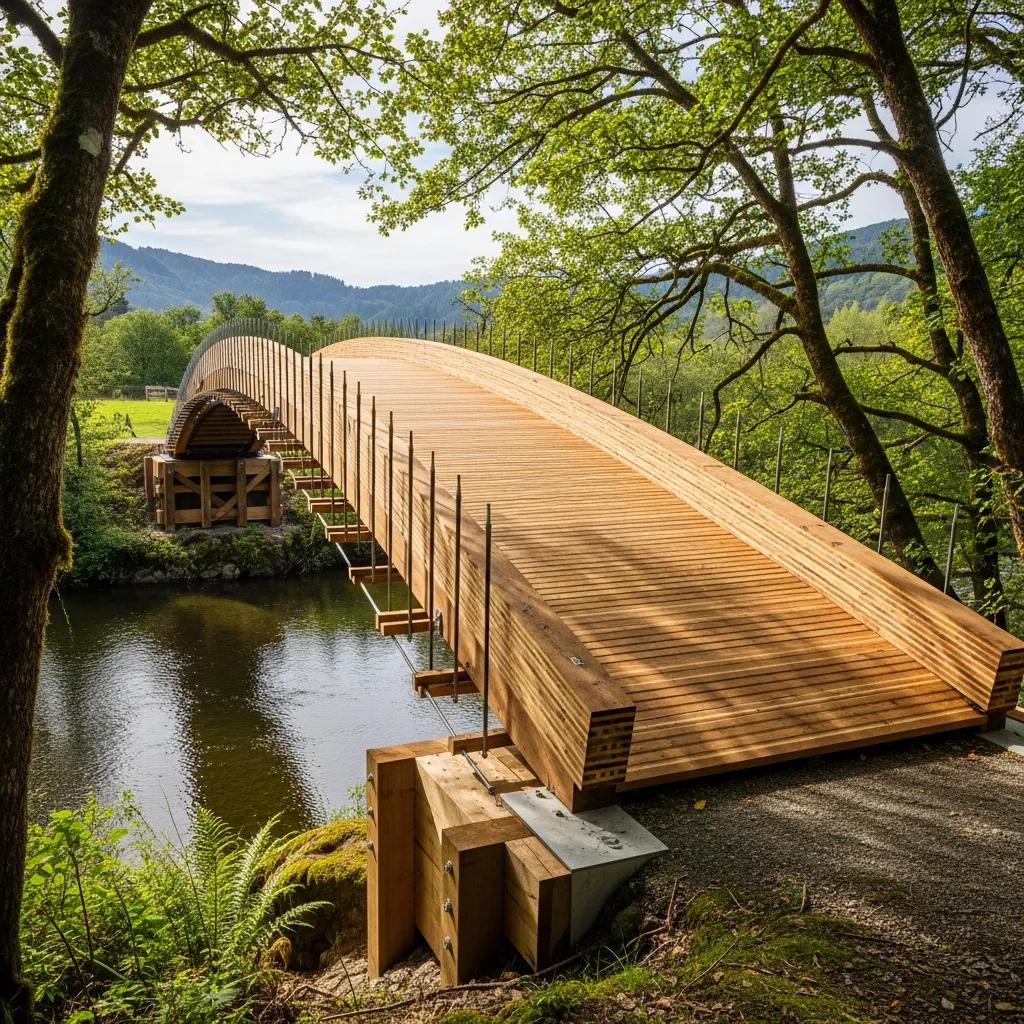
How Stress Lamination Works: A Technical Explainer on Stress Laminated Timber Bridges
Stress lamination is an advanced engineering technique used in timber bridge construction to enhance structural integrity and extend service life. This process involves layering timber planks or beams and applying a pre-stressing force that compresses the laminations together, significantly increasing load capacity and stiffness. Stress-laminated timber bridges provide a sustainable, efficient alternative to traditional materials, offering comparable performance with reduced environmental impact. According to the American Wood Council, SLT bridges can achieve load capacities similar to steel and concrete while lowering carbon emissions by up to 30%. This article provides a detailed technical overview of how stress lamination works, the design principles behind SLT bridges, their structural advantages, and the fabrication and assembly processes involved.
How Stress Lamination Works in Timber Bridge Construction
Stress lamination in timber bridge construction involves bonding multiple timber layers and applying a compressive force through high-strength steel rods. This pre-stressing creates friction between the laminations, enabling the bridge deck to act as a single composite unit. The process improves load distribution, reduces peak stresses, and enhances durability. Key steps include:
Material selection: Choosing high-strength, durable timber species such as Douglas fir or Southern yellow pine.
Lamination: Arranging timber planks or glulam beams side by side.
Pre-stressing: Applying tension to steel rods that compress the timber layers tightly together.
Installation: Transporting and assembling the pre-stressed components on-site with precise alignment.
Material selection: Choosing high-strength, durable timber species such as Douglas fir or Southern yellow pine.
Lamination: Arranging timber planks or glulam beams side by side.
Pre-stressing: Applying tension to steel rods that compress the timber layers tightly together.
Installation: Transporting and assembling the pre-stressed components on-site with precise alignment.
This method allows SLT bridges to support heavier loads and span longer distances than conventional timber bridges, with service lives exceeding 50 years under proper maintenance.
What is stress lamination in timber bridge construction?
Stress lamination is a process where multiple timber layers are compressed together using high-strength steel rods to create a composite structural element. This pre-stressing enhances load capacity and stiffness by increasing frictional forces between laminations.
Full-scale ultimate-load test of a stress-laminated-timber bridge deck, R Kliger, 2012
What is stress lamination in timber bridge construction?
Stress lamination is a process where multiple timber layers are compressed together using high-strength steel rods to create a composite structural element. This pre-stressing enhances load capacity and stiffness by increasing frictional forces between laminations.
Full-scale ultimate-load test of a stress-laminated-timber bridge deck, R Kliger, 2012
Fundamental Design Principles of Stress Laminated Timber Bridges
The design of SLT bridges centers on creating a composite action between timber layers to efficiently transfer loads and resist deformation. Key principles include:
Composite Action: Friction between tightly compressed laminations enables the deck to behave as a unified structural element.
Material Selection: Timber species with high strength-to-weight ratios and durability are essential for long-term performance.
Modular Design: Prefabricated components allow rapid assembly and adaptability to various span lengths and load requirements.
Load Distribution: Pre-stressing ensures even load transfer across the deck, minimizing localized stresses.
Composite Action: Friction between tightly compressed laminations enables the deck to behave as a unified structural element.
Material Selection: Timber species with high strength-to-weight ratios and durability are essential for long-term performance.
Modular Design: Prefabricated components allow rapid assembly and adaptability to various span lengths and load requirements.
Load Distribution: Pre-stressing ensures even load transfer across the deck, minimizing localized stresses.
Research from the USDA Forest Products Laboratory confirms that well-designed SLT bridges can exceed 50 years of service life with minimal maintenance.
Key Engineering Advantages of Stress Laminated Timber Bridges
Stress laminated timber bridges offer several mechanical and structural benefits that distinguish them from traditional timber and other bridge types:
Enhanced Load Capacity: Pre-stressing and composite action allow SLT bridges to carry loads up to 40% greater than conventional timber bridges.
Improved Stiffness: Increased compression between laminations results in up to 35% greater stiffness, reducing deflections under load.
Reduced Peak Stresses: Pre-stressing minimizes stress concentrations, lowering the risk of cracking and deformation.
Durability: Tight compression and preservative treatments extend service life and resistance to environmental degradation.
Sustainability: Use of renewable timber reduces embodied carbon by up to 60% compared to steel alternatives.
Enhanced Load Capacity: Pre-stressing and composite action allow SLT bridges to carry loads up to 40% greater than conventional timber bridges.
Improved Stiffness: Increased compression between laminations results in up to 35% greater stiffness, reducing deflections under load.
Reduced Peak Stresses: Pre-stressing minimizes stress concentrations, lowering the risk of cracking and deformation.
Durability: Tight compression and preservative treatments extend service life and resistance to environmental degradation.
Sustainability: Use of renewable timber reduces embodied carbon by up to 60% compared to steel alternatives.
Structural Advantage
Description
Impact Level
Enhanced Load Capacity
Composite action through pre-stressed laminations
High
Improved Stiffness
Increased compression reduces deflections
High
Reduced Peak Stresses
Minimization of stress concentrations
Medium
Durability
Extended service life via compression and treatments
High
Sustainability
Lower embodied carbon through timber use
High
How do stress laminated timber bridges work?
SLT bridge decks consist of multiple timber planks or glulam beams placed side by side and compressed together using high-strength steel rods. The pre-stressing creates frictional forces that distribute concentrated loads across adjacent beams, enabling the deck to act as a composite unit with enhanced load capacity and durability.
Stress-laminated-timber decks: state of the art and design based on Swedish practice, R Kliger, 2016
How do stress laminated timber bridges work?
SLT bridge decks consist of multiple timber planks or glulam beams placed side by side and compressed together using high-strength steel rods. The pre-stressing creates frictional forces that distribute concentrated loads across adjacent beams, enabling the deck to act as a composite unit with enhanced load capacity and durability.
Stress-laminated-timber decks: state of the art and design based on Swedish practice, R Kliger, 2016
Fabrication and Assembly Process of Stress Laminated Timber Bridges
Material Selection and Preparation
High-quality timber species such as Douglas fir and Southern yellow pine are selected for their strength and durability. Timber is treated with preservatives to protect against environmental factors and pests, extending service life by up to 20 years. Steel rods with tensile strengths exceeding 1,200 MPa are used for pre-stressing.
Lamination and Pre-stressing
Timber planks or glulam beams are arranged side by side and bonded. High-strength steel rods are tensioned using calibrated hydraulic jacks to apply compressive forces up to 150 kN per rod, ensuring tight compression between laminations.
Installation and Final Assembly
Pre-stressed components are transported to the site and installed with precise alignment and support. Installation times are typically 30% faster than traditional timber bridge methods due to modular design and prefabrication. Learn more about our custom bridge fabrication and manufacturing processes that ensure quality and performance.
What are the key steps in fabrication and assembly?
The fabrication process includes material preparation with moisture control and preservative treatment, precise assembly with tensioning of steel rods, and rigorous quality checks such as non-destructive testing and load simulations to ensure safety and performance.
What are the key steps in fabrication and assembly?
The fabrication process includes material preparation with moisture control and preservative treatment, precise assembly with tensioning of steel rods, and rigorous quality checks such as non-destructive testing and load simulations to ensure safety and performance.
Applications of Stress Laminated Timber Bridges in Construction
SLT bridges are versatile and suitable for a range of construction scenarios, including:
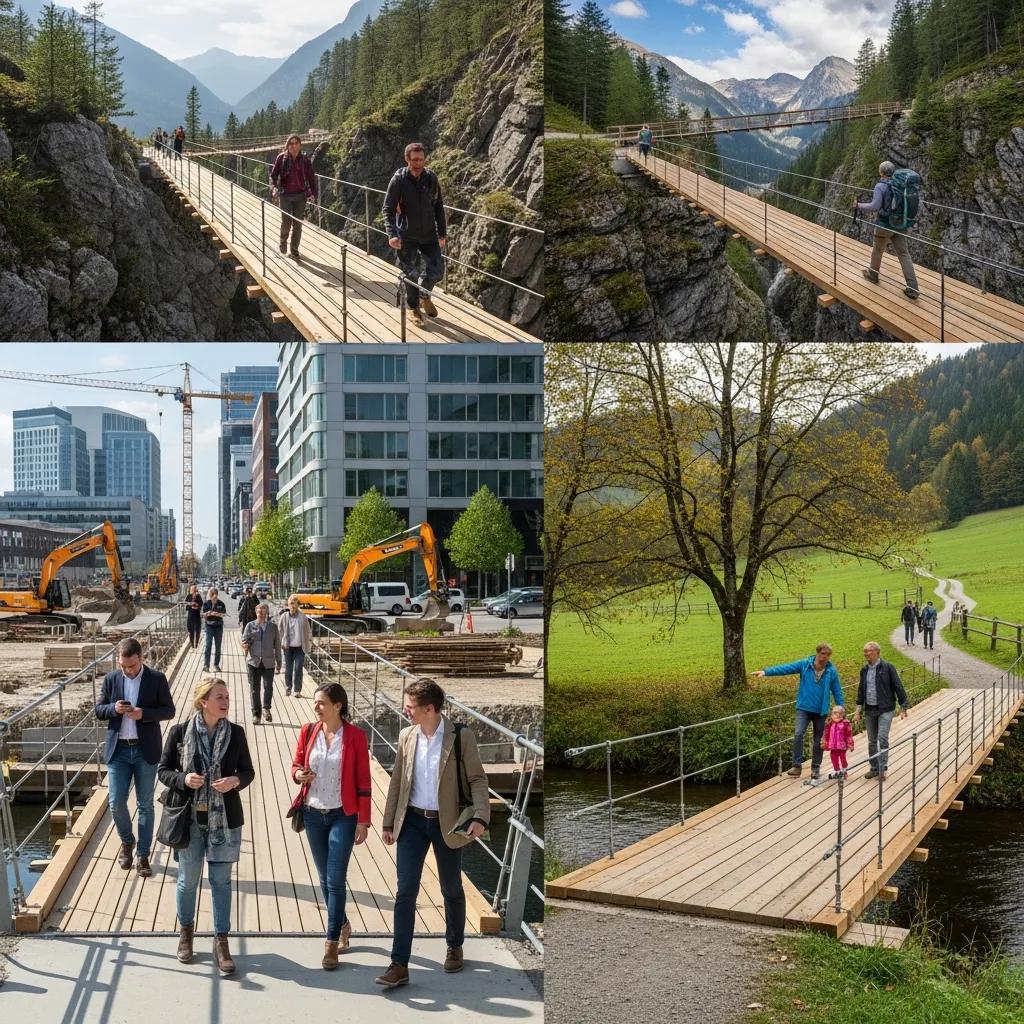
Temporary Crossings: Rapid installation makes SLT bridges ideal for short-term projects. The U.S. Forest Service notes that temporary SLT bridges can be installed in under 48 hours, minimizing disruption. Learn more about temporary bridge solutions.
Environmentally Sensitive Areas: Timber bridges reduce soil disturbance and preserve water quality better than concrete alternatives, making them suitable for ecologically sensitive sites.
Urban and Rural Use: SLT bridges accommodate pedestrian, vehicular, and light rail traffic, adapting to diverse load and traffic requirements.
Temporary Crossings: Rapid installation makes SLT bridges ideal for short-term projects. The U.S. Forest Service notes that temporary SLT bridges can be installed in under 48 hours, minimizing disruption. Learn more about temporary bridge solutions.
Environmentally Sensitive Areas: Timber bridges reduce soil disturbance and preserve water quality better than concrete alternatives, making them suitable for ecologically sensitive sites.
Urban and Rural Use: SLT bridges accommodate pedestrian, vehicular, and light rail traffic, adapting to diverse load and traffic requirements.
Why are stress laminated timber bridges effective for temporary and permanent use?
Their rapid deployment, modular design, and durability make SLT bridges suitable for both emergency temporary crossings and long-term infrastructure. The Federal Highway Administration reports installation times as short as 24 hours, reducing traffic disruption and supporting emergency response.
Why are stress laminated timber bridges effective for temporary and permanent use?
Their rapid deployment, modular design, and durability make SLT bridges suitable for both emergency temporary crossings and long-term infrastructure. The Federal Highway Administration reports installation times as short as 24 hours, reducing traffic disruption and supporting emergency response.
Comparing Stress Laminated Timber Bridges to Glulam Bridges
While both use engineered timber, SLT and glulam bridges differ fundamentally in construction and performance:
Layering Technique: SLT bridges use pre-stressed, tightly compressed layers bonded by friction, whereas glulam bridges rely on glued laminated beams without pre-stressing.
Load Capacity: Pre-stressing in SLT bridges typically results in up to 20% higher load ratings compared to glulam bridges.
Maintenance: SLT bridges often have lower long-term maintenance costs due to reduced creep and fatigue susceptibility.
Layering Technique: SLT bridges use pre-stressed, tightly compressed layers bonded by friction, whereas glulam bridges rely on glued laminated beams without pre-stressing.
Load Capacity: Pre-stressing in SLT bridges typically results in up to 20% higher load ratings compared to glulam bridges.
Maintenance: SLT bridges often have lower long-term maintenance costs due to reduced creep and fatigue susceptibility.
What makes SLT bridges different from glulam bridges?
SLT bridges achieve composite action through pre-stressing multiple timber layers, enhancing load distribution and stiffness. Glulam bridges consist of glued laminated beams without pre-stressing, resulting in different structural behaviors and performance metrics.
What makes SLT bridges different from glulam bridges?
SLT bridges achieve composite action through pre-stressing multiple timber layers, enhancing load distribution and stiffness. Glulam bridges consist of glued laminated beams without pre-stressing, resulting in different structural behaviors and performance metrics.
Industries Benefiting from Stress Laminated Timber Bridges
SLT bridges serve multiple sectors, including:
Construction: Providing cost-effective, sustainable solutions for both temporary and permanent structures.
Forestry: Enabling access to remote areas with minimal environmental impact. SLT bridges reduce soil compaction and preserve habitats. Explore temporary logging bridge options for forestry operations.
Environmental Management: Supporting infrastructure development in sensitive ecological zones with reduced disturbance.
Construction: Providing cost-effective, sustainable solutions for both temporary and permanent structures.
Forestry: Enabling access to remote areas with minimal environmental impact. SLT bridges reduce soil compaction and preserve habitats. Explore temporary logging bridge options for forestry operations.
Environmental Management: Supporting infrastructure development in sensitive ecological zones with reduced disturbance.
Rapid Deployment for Emergency and Temporary Bridge Needs
Stress laminated timber bridges offer rapid deployment capabilities critical for emergency response and temporary infrastructure. Their modular design and lightweight components enable quick transport and installation, restoring connectivity swiftly after disasters or infrastructure failures. The National Institute of Standards and Technology highlights that SLT bridges can reestablish transportation links within 48 hours, facilitating disaster relief efforts. For emergency applications, see emergency temporary bridge solutions.
Summary: How Stress Lamination Enhances Timber Bridge Performance
Stress lamination improves timber bridge performance by:
Creating a composite structural element through pre-stressed timber layers.
Enhancing load capacity and stiffness via frictional forces between laminations.
Reducing peak stresses and deformation under heavy loads.
Extending durability with tight compression and preservative treatments.
Enabling rapid fabrication and installation for diverse applications.
Creating a composite structural element through pre-stressed timber layers.
Enhancing load capacity and stiffness via frictional forces between laminations.
Reducing peak stresses and deformation under heavy loads.
Extending durability with tight compression and preservative treatments.
Enabling rapid fabrication and installation for diverse applications.
This technique supports both temporary and permanent infrastructure needs with sustainable, high-performance timber solutions. Learn more about the expertise of E&H Manufacturing in delivering advanced timber bridge projects.
Explore Stress Laminated Timber Bridge Solutions with E&H Manufacturing
E&H Manufacturing specializes in the design and fabrication of stress laminated timber bridges tailored to industrial, governmental, and land development projects. To learn more about how SLT bridges can meet your project requirements or to discuss custom bridge solutions, visit E&H Manufacturing or contact our team directly through our contact page.